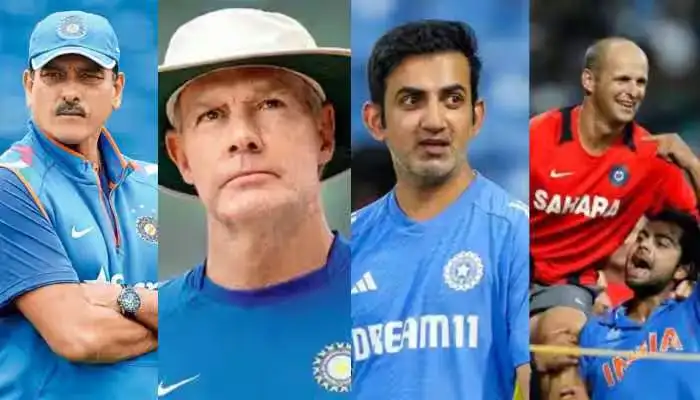
Know Around 17 Indian Cricket Group Coaches From 1971 Till 2026
Cricket in India is more than a sport—it is a feeling shared by millions. Whereas players sparkle on the field, a solid support framework works behind the scenes. At the heart of this framework are the coaches who arrange techniques, support ability, and direct the group through triumphs and misfortunes. From 1971 to 2026, the Indian cricket team has seen 17 head coaches who formed its team over generations.

Early A long time of Indian Cricket Coaching (1971–1990)
India’s coaching travel started with Raj Singh Dungarpur (1971–1974), who centered on prepping youthful players and building talent. He was succeeded by Hemu Adhikari (1979–1980), who emphasized collaboration and coordination.
In the early 1990s, amazing spinner Bishen Singh Bedi (1990–1991) took charge and attempted to reinforce India’s bowling assault. After a while, Abbas Ali Baig (1991–1992) worked closely with developing ability, planning the following era of cricketers.
Building Solidness and Structure (1992–1999)
Former captain Ajit Wadekar (1992–1996) brought stability to the group, making a difference in India’s rule of domestic conditions. Madan Lal (1996–1997) briefly served as coach and pointed out adjustments to batting, bowling, and fielding.
Anshuman Gaekwad (1997–1999, 2000) had two stretches and centered on solidarity inside the squad amid a transitional phase.
Experimentation and Remote Impact (1999–2007)
Kapil Dev (1999–2000) brought animosity and vitality but fell in the midst of discussions. A major turning point came with John Wright (2000–2005), India’s first outside coach. Beneath him, India accomplished memorable overseas achievements and came to the 2003 World Cup final.
Greg Chappell (2005–2007) energized youth but confronted feedback for inner clashes. In particular, Lalchand Rajput (2007) had a brief, however famous residency, guiding India to triumph in the inaugural T20 World Cup.
Golden Stage of Indian Cricket (2008–2015)
Gary Kirsten (2008–2011) managed one of India’s most fruitful periods, counting the 2011 ODI World Cup win and the rise to No.1 in Test rankings. Duncan Fletcher (2011–2015) led the victory with the 2013 Champions Trophy, in spite of blended abroad results.
Modern Time and Worldwide Dominance (2014–2024)
Ravi Shastri (2014–2016, 2017–2021) built an intrepid, fast-bowling unit that helped India’s to begin with a Test series win in Australia. Anil Kumble (2016–2017) reinforced India’s domestic dominance, some time recently venturing down.
Rahul Dravid (2021–2024) centered on profundity, consistency, and youth advancement, driving India to the 2024 T20 World Cup title.
Present and Future (2024–2026)
Gautam Gambhir (2024–present) is the most recent expansion. Known for his forceful mentality and winning attitude, his desires are as tall as his coaching travel begins.
Conclusion
From sustaining crude ability to winning the World Cup, Indian cricket coaches have played a vital part in forming India’s victory. Each coach brought a one-of-a-kind vision, making a difference as the group advances with changing times. As Indian cricket moves forward, its solid coaching bequest guarantees the group remains in able hands.