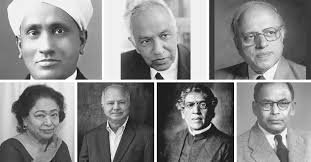
India has produced some of the world’s most influential scientists across space research, physics, biotechnology, medicine, agriculture, and engineering. By 2026, both legendary pioneers and modern innovators continued shaping India’s global scientific reputation.
1. A. P. J. Abdul Kalam
Known as the “Missile Man of India,” Abdul Kalam played a major role in India’s missile and space programs through ISRO and DRDO.
Major Contributions:
- Agni and Prithvi missile programs
- India’s defence modernization
- Space launch vehicle development
- Scientific education inspiration
Even in 2026, he remained one of India’s most admired scientists and youth icons.
Also read: Arthika Biography


2. C. V. Raman
C. V. Raman discovered the famous Raman Effect, earning India’s first Nobel Prize in science in 1930.
Major Contributions:
- Raman scattering theory
- Optical physics
- Molecular spectroscopy
National Science Day in India is celebrated in his honor.
3. Vikram Sarabhai
Vikram Sarabhai laid the foundation for India’s space research initiatives and established modern Indian space science.
Major Contributions:
- Founder of ISRO
- Satellite communication programs
- Space technology for rural development
His vision continues to influence India’s space missions in 2026.
4. Homi J. Bhabha
Known as the father of India’s nuclear program, Homi Bhabha established major scientific institutions and promoted atomic research.
Major Contributions:
- India’s nuclear energy program
- Establishment of Tata Institute of Fundamental Research
- Atomic energy development
5. M. S. Swaminathan
M. S. Swaminathan led India’s Green Revolution and transformed Indian agriculture.
Major Contributions:
- High-yield crop varieties
- Food security improvements
- Agricultural genetics
He remains one of the most respected agricultural scientists globally.


6. Satyendra Nath Bose
S. N. Bose co-developed Bose-Einstein statistics with Albert Einstein.
Major Contributions:
- Quantum mechanics
- Boson particle theory
- Statistical mechanics
The term “boson” was named after him.
7. Jagadish Chandra Bose
Jagadish Chandra Bose pioneered work in wireless communication and plant physiology.
Major Contributions:
- Radio and microwave research
- Plant response studies
- Early wireless technology
8. Venkatraman Ramakrishnan
Venkatraman Ramakrishnan won the Nobel Prize in Chemistry for his work on ribosome structure.
Major Contributions:
- Structural biology
- Ribosome research
- Protein synthesis studies
His research revolutionized molecular biology and medical science.
9. Gagandeep Kang
Dr. Gagandeep Kang became one of India’s leading medical scientists and vaccine researchers.
Major Contributions:
- Vaccine development
- Viral disease research
- Public health microbiology
She became the first Indian woman elected as Fellow of the Royal Society.
10. V. Narayanan
By 2026, V. Narayanan emerged as one of India’s leading active scientists through his leadership at ISRO.
Major Contributions:
- Space mission operations
- Chandrayaan-related programs
- AI integration in space research
- Human spaceflight advancements


Other Famous Indian Scientists
Some other highly respected Indian scientists include:
- Har Gobind Khorana
- Subrahmanyan Chandrasekhar
- A. E. Muthunayagam
- Kasturirangan
- Ritu Karidhal
- Tessy Thomas
Why Indian Scientists Are Important Globally
Indian scientists have contributed significantly in:
- Space technology
- Nuclear science
- Quantum physics
- Biotechnology
- Agriculture
- Medicine
- Artificial intelligence
- Environmental science
By 2026, India had become a major global scientific power in:
- Space missions
- Vaccine production
- Digital technology
- Genomics and biotechnology
- AI-driven healthcare research
Also read: https://everythingbollywood.in/gunjan-singh-age-net-worth-height-family-wife-biography-in-2026/